






Wagyu Fat Melting Point – The Science of Umami
Introduction
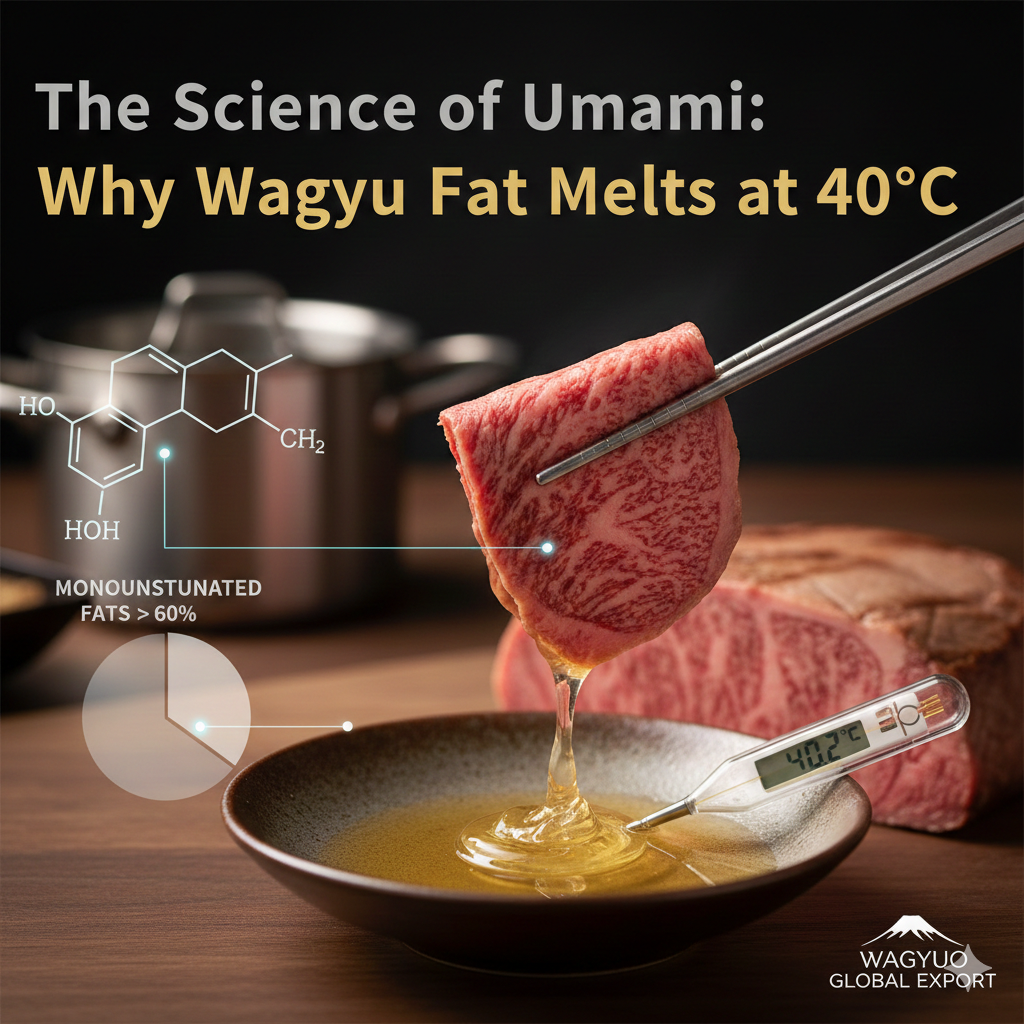
The Wagyu fat melting point is what makes Wagyu feel so different from other beef. It is not simply “marbled meat”: its fat has a distinctive lipid profile, and for importers, the “melt-in-the-mouth” sensation that results is a large part of its value, one that comes down to molecular science. Standard beef fat melts at around 45 to 50°C, while the fat of authentic Japanese Wagyu (Kuroge Washu) melts at a noticeably lower temperature, often cited as 20 to 40°C.
In this technical deep-dive, we explore why Wagyu fat melts at such low temperatures and how this chemistry shapes its flavor.
1. The Key Factor: High Concentration of Oleic Acid
The melting point of beef fat is determined by its fatty acid composition. The primary differentiator for Wagyu is the high ratio of Monounsaturated Fatty Acids (MUFA), specifically Oleic Acid.
Saturated vs. Unsaturated
- Saturated Fatty Acids: Solid at room temperature (High melting point).
- Unsaturated Fatty Acids (Oleic Acid): Liquid at room temperature (Low melting point).
Top-tier Japanese Wagyu often contains over 55% to 60% Oleic Acid. This chemical makeup ensures that the fat begins to liquefy even before it reaches human body temperature ($37^\circ\text{C}$), creating the hallmark buttery texture.
2. Why the “40°C” Threshold Matters
The threshold of 40℃ is critical for the culinary experience. Because Wagyu’s melting point is lower than or near human body temperature, the fat dissolves instantly upon contact with the tongue.
Comparative Analysis of Melting Points
| Cattle Breed | Average Melting Point | Palate Experience |
| Japanese Wagyu | 25℃ – 40℃ | Instant melt, “silky” mouthfeel, light aftertaste |
| Standard Grain-fed | 45℃ – 50℃ | Chewy texture, fat remains solid on the palate |
For importers, this data point is a powerful sales tool: Wagyu is not “greasy” in the traditional sense; it is a flavor-carrying liquid at consumption temperature.
3. “Wagyu-ko”: The Chemistry of Aroma
The low melting point does more than affect texture; it acts as a delivery system for Wagyu-ko (Wagyu Aroma). When the fat melts, it releases volatile compounds that define its premium status.
- Lactones: These are organic compounds that produce a sweet, coconut-like, or fruity aroma.
- Retro-nasal Olfaction: As the fat melts at 40℃ during mastication, these lactones are released into the retro-nasal passage, resulting in a rich, lingering fragrance that is absent in other beef varieties.
4. Technical Advice for Importers and Chefs
Understanding the science of the 40℃ melting point is essential for maintaining product quality:
- Precision Searing: High heat is required to trigger the Maillard reaction on the surface, but the interior must be handled delicately to prevent the “Umami oils” from rendering out completely.
- Temperature Control: Due to the low melting point, Wagyu fat can oxidize or soften quickly at room temperature. It should be kept chilled until the moment of preparation to preserve its structural integrity.
Conclusion: Wagyu as a Scientific Masterpiece
The 40℃ melting point is the objective proof of Wagyu’s superiority. It is the result of centuries of selective breeding and specialized Japanese husbandry. For the discerning importer, selling Wagyu is not just selling meat—it is selling a sophisticated chemical reaction that peaks at the moment of the first bite.
