






Which Wagyu Cuts Work Best in Each Country and Business Model
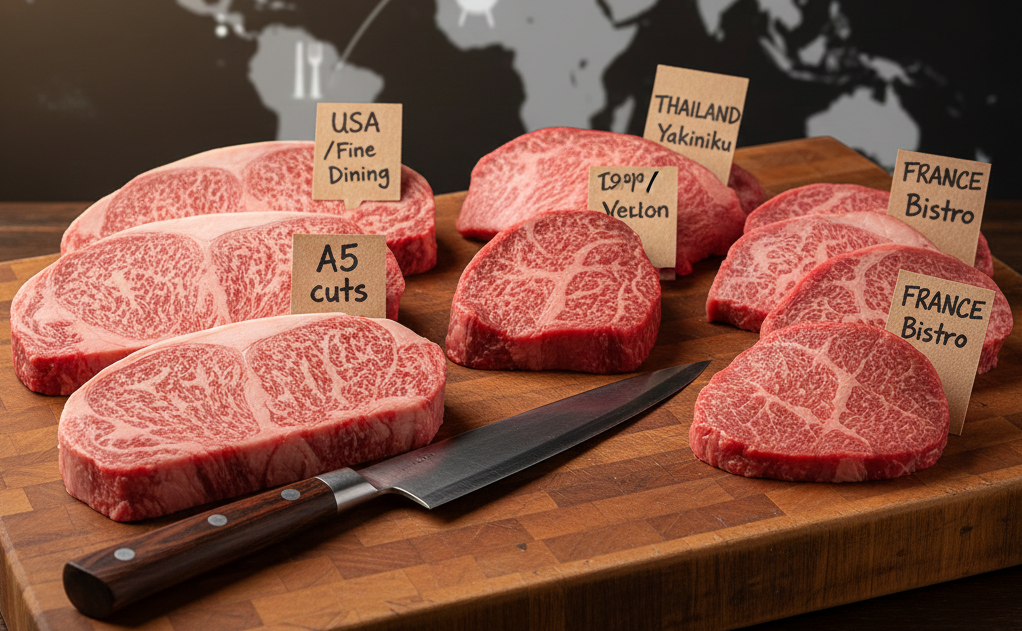
Matching Wagyu Cuts with Global Markets and Foodservice Businesses
In the global Wagyu trade, there is still a widespread assumption that
“A5 is always the best” or “sirloin and ribeye are the safest choices.”
However, in actual B2B transactions, the most suitable Wagyu cut varies significantly depending on
local food culture, business model, kitchen operations, and target price range.
Wagyu is not a product evaluated by grading alone.
Its true value emerges when the right cut is matched with the right country and the right type of business.
This strategic alignment is what leads to repeat orders and long-term partnerships, rather than one-off transactions.
In this article, we examine major export markets and organize practical insights from the perspective of
Country × Business Model × Wagyu Cut.
Three Key Factors When Selecting Wagyu Cuts
1. Fat Content (BMS) and Cultural Compatibility
While a high BMS score is a defining characteristic of Wagyu, it is not universally preferred.
- Fine dining or luxury concepts → High BMS works well in small portions
- Main-dish or everyday dining → Moderate fat or leaner cuts are often preferred
The key question is not “Is it well-marbled?” but “Is the level of marbling appropriate?”
2. Cooking Suitability and Kitchen Operations
The same cut can perform very differently depending on how it is used:
- Thick-cut steaks
- Thin slicing
- Roasting or slow cooking
Understanding local kitchen workflows is essential when proposing Wagyu cuts.
3. Cost Structure and Menu Positioning
Is the Wagyu used as:
- A signature, premium item?
- A core menu component with volume?
Not every menu requires top-tier cuts. Strategic cut selection enables better margins and stability.
Recommended Wagyu Cuts by Country and Business Model
United States
Market Characteristics
- Strong steak culture, preference for meat texture
- Wagyu compared directly with grain-fed beef
Suitable Business Models
- Steak houses
- Fine dining restaurants
- Premium burger concepts
Recommended Cuts
- Sirloin
- Ribeye
- Lean cuts such as Ichibo or Uchimomo
Key Insight
Rather than A5 alone, A3–A4 Wagyu with balanced marbling often performs better, offering both Wagyu character and satisfying bite.
France
Market Characteristics
- Sauce-based cuisine
- Chef-driven evaluation
- Emphasis on lingering umami and aroma
Suitable Business Models
- Gastronomic restaurants
- Bistros
- Chef’s table concepts
Recommended Cuts
- Rump
- Kurimi
- Chuck roll
Key Insight
Flavor depth matters more than visual marbling. Storytelling around the cut and producer adds strong value.
United Kingdom
Market Characteristics
- Roast and grill culture
- Simple cooking highlights raw ingredient quality
Suitable Business Models
- Pub restaurants
- Hotel dining
- Roast-focused establishments
Recommended Cuts
- Ribeye
- Sirloin
- Chuck roll
Key Insight
Consistency and stable supply are critical. Trimmed, boneless specifications are often preferred.
Singapore
Market Characteristics
- Luxury-driven dining scene
- Strong focus on appearance and brand value
Suitable Business Models
- High-end yakiniku
- Japanese restaurants
- Luxury hotels
Recommended Cuts
- Sirloin
- Ribeye
- Short rib and other karubi cuts
Key Insight
A4–A5 Wagyu delivers clear visual impact. Small-portion, high-price menus are the norm.
Hong Kong
Market Characteristics
- High Wagyu literacy
- Fusion of yakiniku, hot pot, and Japanese cuisine
Suitable Business Models
- Premium yakiniku
- Wagyu specialty restaurants
- Hot pot concepts
Recommended Cuts
- Brisket and plate
- Chuck roll
- Uchimomo for thin slicing
Key Insight
Mixed-cut or use-specific proposals are effective. Detailed cut and slicing recommendations increase competitiveness.
Middle East
Market Characteristics
- Halal compliance required
- Grilling and roasting-centered cuisine
Suitable Business Models
- Fine dining restaurants
- Hotel banquets
- Private dining concepts
Recommended Cuts
- Rump
- Uchimomo
- Shoulder cuts
Key Insight
Lean-focused preferences dominate. Certification, traceability, and supply reliability are decisive factors.
Practical Checklist for Successful Cut Selection
- Separate traditional food culture from emerging trends
- Identify whether decisions are chef-driven or operation-driven
- Clarify whether the cut is for a signature dish or a standard SKU
- Focus on “how it will be used,” not only on grading
Wagyu sells not because it is expensive, but because its purpose is clearly defined.
Conclusion: Cut Strategy Is a Competitive Advantage in Wagyu Exports
There is no single Wagyu cut that fits every market.
However, by aligning:
- Local preferences
- Business models
- Cooking methods
Wagyu becomes a powerful product that avoids price competition and builds long-term value.
Matching the right cut to the right country and business model is the first step toward sustainable Wagyu exports.
Final Note
From a business perspective, we would be pleased to propose the most suitable Wagyu cuts for your specific market and business model.
Please feel free to contact us for further consultation.
